
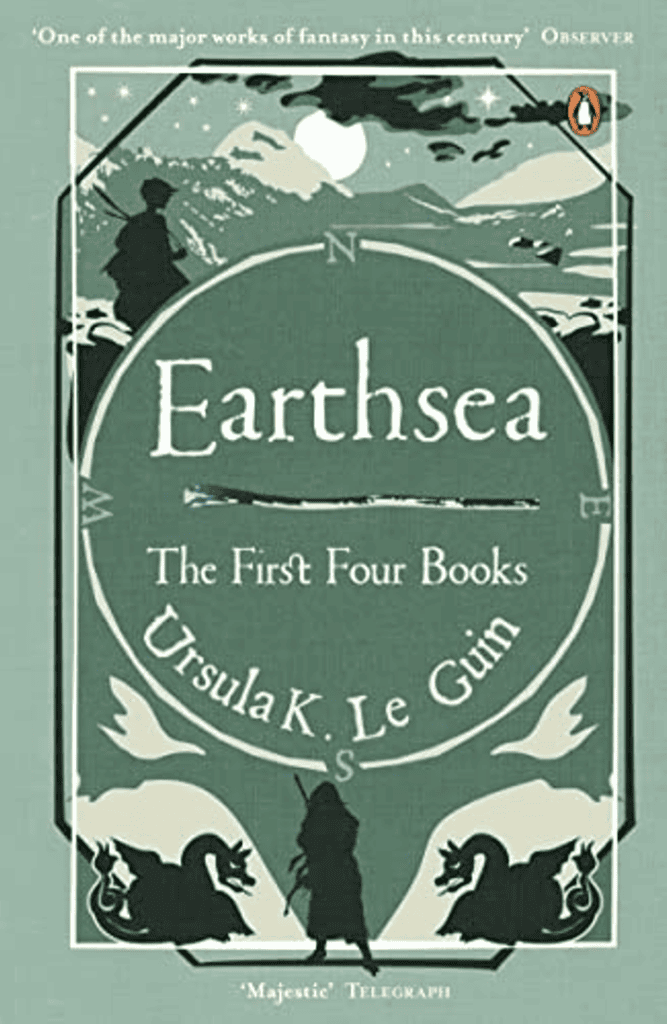
I’d been quite excited to read this one for a while. It was a Christmas present, and I’d been told that Ursula Le Guin was “the birth of modern fantasy”. Tolkien’s predating her by about a decade aside, it was certainly interesting.
One disclaimer: the edition I read was the original Earthsea quartet of A Wizard of Earthsea, The Tombs of Atuan, The Farthest Shore, and Tehanu. It did not include the two later books written to finish the series.
A Wizard of Earthsea
When I started reading, I was a little underwhelmed, honestly. I could immediately see where Le Guin’s ideas of a young nobody discovering his talent for magic, inspired later fantasy writers, including my personal favourite, David Eddings’ Pawn of Prophecy. But more generally, and certainly with the first book, I found it rushed through the whole affair quite quickly. The boy Ged’s village is attacked by Kargs, who are driven off by his mists. Then he is taken to the mage Ogion to be taught, before going to Roke. He studies at Roke and completes the entire education of magic in about 10 pages. It isn’t until he starts messing stuff up that the pace of the story seems to slow down.
Whilst this is a refreshing break from the usual process of slow build-ups, I found it hard to associate with the character of Ged in those first few chapters and through the book as a whole. Whether that was to do with the speed or something else of Le Guin’s craft not sitting well with me, I cannot say. My thoughts on A Wizard of Earthsea are that it is quite a good setup for the rest of the series and introducing the character of Ged (or Sparrowhawk), as well as introducing us to some of the tropes and characters in Earthsea. As a standalone story though, it feels a little rushed.
3.5/5 stars
The Tombs of Atuan
This one was more interesting. As I started reading it, I was a bit confused, and honestly a bit unhappy. Maybe I wasn’t quite so unattached to the character of Ged as I thought! 🤣
Tenar — or as she later become, Arha — was a strange jump from the islands of the Earthsea archipelago. However, soon enough, I came to enjoy the fresh perspective on the world, as well as the mystery and lore behind the One Priestess, and the supposed eldritch horrors of The Nameless Ones. When Ged turned up once again as the mage Sparrowhawk, it was enjoyable to see the story unfold with its intricacies of changing Arha’s perspective and getting her to realise that her life was not confined to the tombs. Maybe this was a setup for book four, I do not know. I definitely enjoy this one more than book one though.
The Tombs of Atuan seemed to resonate with me more than with any other book in this series. Possibly for the mystery and hidden political power of the Godking, the notion of another civilisation separate to the Earthsea archipelago, or maybe the influences of ancient mythology such as the Labyrinth. I have always been a fan of history and storytelling and mythology, and this book seemed to capture that more than any particular adventure story.
My only issue with this is potentially also its greatest strength: it seems a bit detached, certainly compared to the other three books. It sets up the character of Tenar to reappear later, and it shows us another area of the world of Earthsea. Beyond that though, the general tale of Ged the Archmage could continue regardless.
4.5/5 stars
The Farthest Shore
This was your classic adventure-time fantasy novel. The Archmage Sparrowhawk — most powerful man in the world — sets off with a new servant/companion who has a noble ancestry to combat some dark evil emerging in the south-west. Magic is fading from the world, and the mages have sent their greatest to combat it.
What more can I say other than that this was a pleasure to read, as are all other adventure stories. Dragons, sea voyages, new peoples, traditions. A sinister villain on the horizon affecting the world, the land of the dead and the final defeat of the Archmage Ged, all are nothing more than archetypal. Honestly though, I don’t mind it. If you can pull off writing that kind of story that has been done so many times before and since, it works for me, and Le Guin certainly did manage to pull it off.
The interesting aspect of this for me was the twist of the Archmage’s loss of magic. Not returning victorious to Earthsea once more a saviour, he is carried on the back of a dragon to his home island, presumably to live out the rest of his days. It was unusual, but also refreshing to find that new perspective on the tale.
I should also point out that, whether she had changed her pacing, or whether I had simply become accustomed to the flow, the stories didn’t seem quite as rushed. Everything took its own time, and no details were skipped through. That was better.
4/5 stars
Tehanu
The final book in the Earthsea quartet seemed quite interesting, because rather than Ged’s point of view, or some other character as has been the case in the previous books, it returned to Tenar — previously Arha in book two — living out her life on the isle of Gont.
The book carried distinctly feminist perspectives on the world of Earthsea, with us periodically getting insights into Tenar’s thoughts about a woman’s role in society and how one might rise to manipulate it as the men in power do. However, these weren’t fully explored to their fullest as it seemed Tenar returned to her life as a farmhouse wife with Ged.
This book was very much centered around the child Therru, with an odd ending that seemed quite out-of-the-blue for the tempo of the rest of the book. A revelation that Therru is actually Tehanu — one of the last dragons, but then she decides to stay in human form and live with Ged and Tenar, is not unwelcome, but a bit unexpected.
Tehanu was much more centred on the thoughts and feelings of characters we’ve encountered throughout the Earthsea quartet, which is actually quite an interesting style for Le Guin to pursue, and one I found quite interesting.
4/5 stars
Overall, I disagree that Le Guin was “the birth of fantasy”. More aptly, maybe, she was the midwife, helping to put in place the tropes and staples that we accept in modern fantasy tales.
I thoroughly enjoyed this series of books, and would highly recommend it to someone reading fantasy.
Leave a Reply