
The biggest critique I’ve heard about AI — and it’s a reasonable one, let’s be fair — is the environmental concerns, and particularly with regards to water usage. In my case though, I’ve noticed people around me use it almost as a buzz phrase to reject AI without considering the possibility that the two aren’t mutually exclusive. So that’s what I’m doing — proving my friends wrong and writing an interesting article in the meantime.
What is actually meant by the AI water complaint?
At the core of the issue isn’t a global environmental issue: it’s very local. The water cycle on Earth ensures that all water ends up back as water at some point or another. However, that doesn’t help a community whose reservoir is being drained faster than it’s being refilled.
And increasingly it’s being found that those reservoirs aren’t being filled enough, for simple geography. A 2025 Bloomberg analysis found that about two-thirds of data centres in development since 2022 have been in already water-deprived areas. As Peter Colohan of the Lincoln Institute put it: “all water is local”. The UNU-INWEH describes this as a “governance and justice challenge” with people all over the world benefitting at the expense of the communities living in already dry areas near data centres.
So why build in arid regions at all?
The short answer: short-term economics and regulatory gaps.
The first factor seems simple — less populous areas are cheaper to buy and develop on. And if you’re a giant corporation who’s already spent millions on AI, you don’t want to pay even more to house the models you’ve created. The second is arguably more interesting, though.
The Environmental Law Institute (ELI) in the US suggests that data centres should be built in “cooler, wetter regions”. Bloomberg’s analysis cited Texas, California, and Arizona as high-stress zones in which are also the US states with the most data centres in already water-deprived areas.
But does a good AI really need that much power?
In my opinion, no, not really. This is my take on things, so don’t treat it as the Indisputable Truth of Consumer AI Benchmarking™ (unless you really want to, in which case © James Michael).
We are constantly being sold a story that more compute means a better model. But my experience of the three biggest consumer AIs — OpenAI’s ChatGPT, Anthropic’s Claude, and Google’s Gemini — doesn’t back that up from my end.
ChatGPT is a bit slow. Maybe not from a position of the model, but how I interact with it. Through the web app, a decent conversation uses over a gigabyte of my computer’s RAM, and there’s still a latency between typing and the text box updating. Let it go on long enough, and you can’t scroll because the actual text content won’t render. Eventually, the entire screen freezes and you can’t do anything at all. For all I know, ChatGPT might be the best AI ever, but when the “good response time” for an LLM is ~1 second, a window with a frame rate of 2 fps really isn’t ideal.
Gemini is slow in the other way. I’ve not used Gemini much, admittedly (go figure, Google and all that), but whilst it feels faster that ChatGPT by a significant margin, it isn’t intuitive. A task will be completed, but there’s no out-of-the-box ‘thinking’ for want of a better term.
That leaves Claude. Genuinely, I like Claude. It’s good for reasoning and thinking, good at writing code, good at planning and structuring. I also like Anthropic’s anti-weaponisation stance. And as a patriotic Brit I am a huge fan of co-founder Jack Clark. But Claude and Anthropic being the best of the three proprietary, data-hungry, American, Big Tech products, doesn’t make it the best overall.
All three of those products rely on building these huge data centres and from my experience all that power doesn’t necessarily make a product better. Hot take.
Meanwhile, European competition in the AI industry is starting to emerge, and I think they do an excellent job of showcasing just how good a consumer LLM can get without draining every last drop of water for miles.
The French may have the right idea…
One of the biggest European AI products is Vibe made by French company Mistral. Founded in 2023 and originally publishing their AI as “Le Chat” (you could not get a more French name than that), and rebranded it to Vibe in 2026.
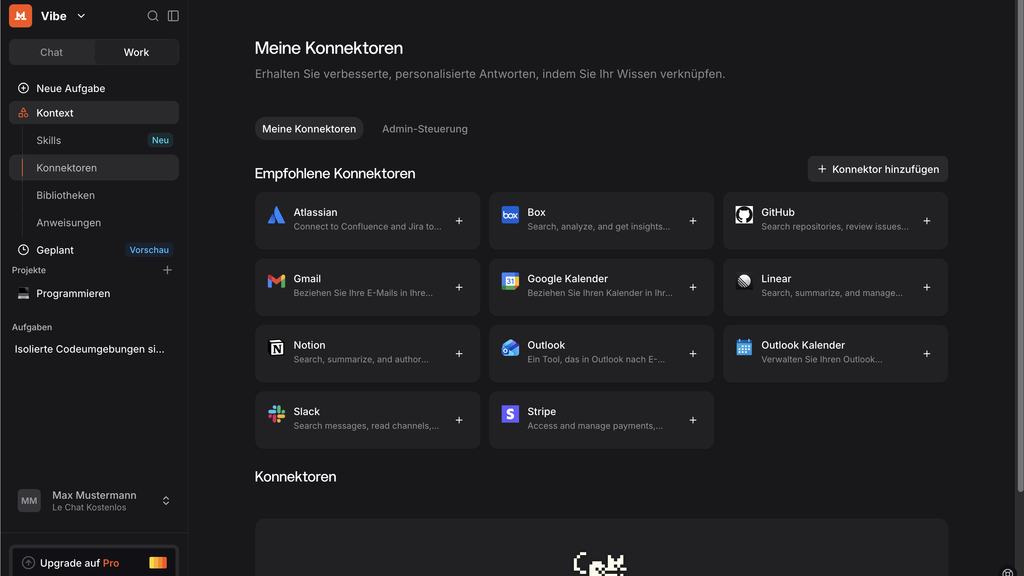
Besides it being under GDPR so all your data is readily erasable and downloadable, and generally having a good design feel and response times, Vibe’s environmental impact is an interesting case study.
Where OpenAI’s only verifiable operating capacity is the ~0.8 GW actually delivered at its Stargate flagship in Abilene, Anthropic expects over 3.5 GW online by the end of 2026. Vibe, meanwhile, runs on under 200 MW of Mistral-operated compute: 77 MW across three sites near Paris and in Sweden. That’s roughly 45× less power than Anthropic, for a product that — in my experience — has response times that blow ChatGPT out of the water and reasons just as well as Claude for anything I throw at it.
Mistral have started deliberately placing new data centres in Sweden and Scandinavia, where naturally cooler temperatures and larger water reserves mean their reliance on coolant is much more sustainable (seriously, why would anyone build a heat-intensive warehouse in Texas? 😂).
My research even suggests that Mistral exports waste-heat locally, in line with the French 2026 mandate. The French power grid is largely nuclear, meaning a much smaller reliance on fossil fuels compared to the rest of the world, and the EU’s climate commitments hold much clearer guidelines on how much companies can contribute to climate change (at least, much stronger than their US counterparts, the administration of which I believe still hasn’t recognised climate change. Says all you need to know, really.
Now, I feel I’m obligated to point out the areas where bias may creep in. First and foremost: the US is where most news comes from. Because it is the centre of the anglosphere, and of the western world more generally, crises and controversies in America get reported around the world far quicker and at louder volumes than anything from France or Sweden.
Secondly, the issues we are facing with these first-generation AI companies like OpenAI are arising many years after their products took off. There is a very real possibility that Mistral has data centre controversy in its future, and they’re just a bit behind everyone else on that front, because they’re newer. Even as I’m writing this, Mistral are committing plans and euros to 200MW of European compute by 2027, and 1GW by 2030. In a few years, I could very well be eating my words as the Swedes start rioting over data centres. But who knows.
So that’s my view on the state of AI currently, and particularly the environmental impact. I don’t think this kind of race between companies can continue for much longer, and at some point the AI bubble will burst. The only question is whether the planet bursts with it.
But Mistral’s Vibe, and Proton’s Lumo and Infomaniak’s Euria prove that good AI models can exist, can push forward with new technologies, and can genuinely offer an experience that doesn’t compromise on sustainability. Touché.